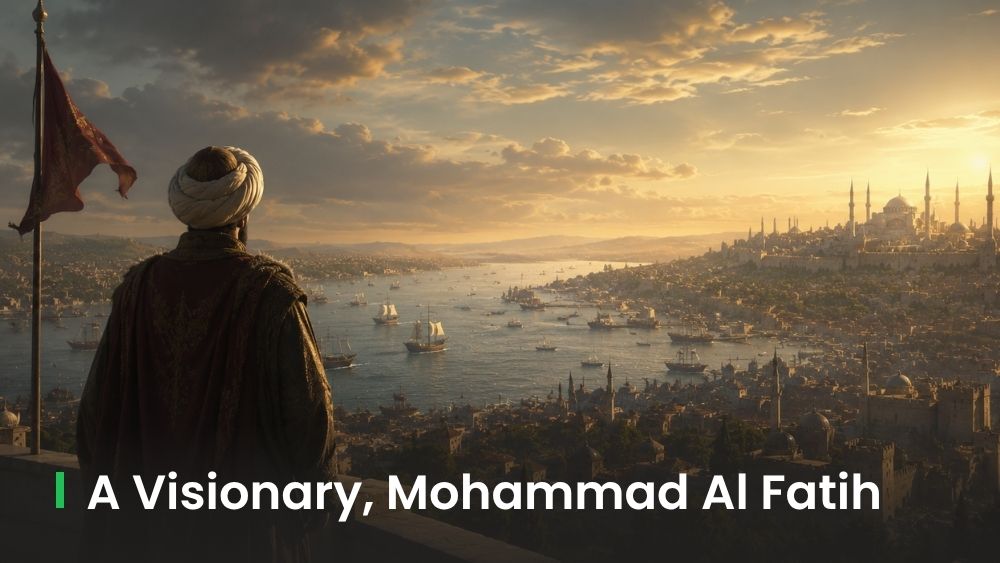
Some people are born into history. Sultan Muhammad Al Fatih was born to make it.
At just 21 years old, he did what no ruler had managed in nearly eight centuries. He conquered Constantinople. Not because he was lucky. Not because he was reckless. But because he carried a vision so rooted in faith and strategy that failure simply was not an option he entertained.
This is the story of a man whose greatest conquest was not a city. It was the limits of what anyone believed was possible.
A Brief Biography
Born on 30th March 1432 in Edirne, Sultan Muhammad Al Fatih was the son of Sultan Murad II. His upbringing was deliberate and intense. He memorised the entire Quran, studied Prophetic narrations, Islamic jurisprudence, mathematics, and astronomy. He trained in warfare not as a hobby but as a calling.
His father appointed only the finest scholars to guide him. Muhammad also governed Amasya as a young prince, gaining real experience in leadership before he had even come of age. By adulthood, he had mastered seven languages: Turkish, Arabic, Persian, Latin, Greek, Serbian, and Hebrew. A ruler. A scholar. A soldier. All before the age of twenty-one.
After his father’s death on 7th February 1451, Muhammad Al Fatih took the throne. He was twenty years old, burning with purpose, and absolutely certain of what he had been placed on this earth to do.
He passed away on 3rd May 1481, leaving behind a transformed empire, a fulfilled prophecy, and a legacy that still echoes today. May Allah have mercy upon him, Ameen.
The Vision That Consumed Him
Most young men inherit ambitions from their fathers. Sultan Muhammad Al Fatih inherited a prophecy from the Prophet himself ﷺ.
The hadith had been known for centuries: “Constantinople will certainly be conquered. How excellent a leader is its leader, and how excellent an army is that army.” [Musnad Ahmad Al-Mustadrak al-Hakim]
Many had tried. All had failed. But for Al Fatih, this was not history. It was a personal address.
His mentor, Sheikh Akshamsaddin, did not teach with fear alone. He pointed Muhammad directly at this prophecy and reminded him of the great leader it described. From that moment, a fire was lit that never went out.
This dream overwhelmed him entirely. He refused to sit in any gathering that was not discussing the conquest. He would not allow those around him to speak of anything else. That is not an obsession. That is vision with total direction.
The Vision of Strategic Genius
Al Fatih did not simply dream of Constantinople. He engineered its fall.
He spent days studying maps, tracing weaknesses in Byzantine defences, and examining every previous failed siege to understand exactly what went wrong. Where others saw an impregnable fortress, he saw a puzzle. And he solved it piece by piece.
His first move was control of the Bosphorus. He built a fortress on the European shore of the strait in just three months, cutting Constantinople off from outside resupply. He personally oversaw its construction.
Then came the weapon that changed everything. A Hungarian engineer named Orban, rejected by the cash-strapped Byzantine Emperor, brought his skills to Al Fatih instead.
The Sultan funded the construction of the largest cannon the medieval world had seen. The great bombard weighed approximately 19 to 30 tonnes and fired granite projectiles of around 540 to 680 kilograms. Its discharge was audible from miles away. Transporting it required 60 to 140 oxen and 200 to 400 men across 230 kilometres of road. This was not brute force. This was military innovation backed by total commitment.
And when the Byzantines chained off the Golden Horn to block the Ottoman fleet? Al Fatih ordered his ships hauled overland, across greased logs cut through the hills of Galata, and relaunched behind the chain. Byzantine defenders woke to find an Ottoman fleet already inside their harbour. No one had ever done such a thing. No one had even thought to.
The Vision of a Righteous Ruler
On 29th May 1453, after a 53-day siege, the Ottoman forces breached the walls. The greatest city in the medieval world had fallen.
What happened next revealed the true depth of Al Fatih’s character.
He rode in not as a destroyer but as a ruler. He ordered his soldiers to stop unnecessary violence. He guaranteed civilian safety. He issued protections for churches and scholars. He chose justice over revenge.
At the Hagia Sophia, he found the people prostrating in fear, weeping over their fate. He dismounted. He offered two rak’ahs of prayer in gratitude to Allah. Then he addressed them directly:
“Stand up. I am Sultan Muhammad. Your lives and your freedoms are under my protection.”
That is not the speech of a conqueror. That is the vision of a statesman.
Do you have any mission in life? If not, read this article to know why this is important.
The Vision of a Civilisation Builder
Conquest was only the beginning. Al Fatih understood that taking a city means nothing if you cannot build something greater within it.
He invited scholars, artists, and thinkers from across the known world, regardless of faith or background. He established universities, constructed mosques, built schools, and transformed a city long in decline. Constantinople, now Istanbul, became a centre of civilisation, learning, and coexistence under his watch.
He implemented sweeping political and social reforms and is recognised as the first Ottoman sultan to codify criminal and constitutional law, long before Suleiman the Magnificent.
He did not just inherit an empire. He reimagined it.
The Secret Behind Every Vision
People look at Al Fatih and see the cannons, the strategy, the boldness. They are right to.
But those who studied him deeply saw something else.
Al Fatih is widely described in Islamic historical accounts as a man who never abandoned his tahajjud or his regular sunnah prayers from puberty until his death. He is said to have chosen soldiers who met the same standard of worship. His army was not merely a fighting force. It was a community of people answerable to Allah.
Note: These accounts are widely repeated in Islamic literature but have not been authenticated through classical hadith scholarship. They are cited here as historically popular narrations, not established fact.
The cannons were tools. Closeness to Allah was the foundation.
What His Vision Teaches Us
Muhammad Al Fatih was not superhuman. He was a man who refused to be ordinary.
He took a prophecy and made it his purpose. He took impossibility and made it his starting point. He took conquest and turned it into compassion.
The Prophet ﷺ said there would be a great leader who would conquer Constantinople. Al Fatih simply spent his entire life making sure that leader would be him.
That is what vision looks like when it is backed by faith, preparation, and an unbreakable connection with Allah.
What vision has Allah placed in your heart? And what are you doing about it today?
Set your vision, mission and goals using Sadiq app!
References:
Leave a Reply